Introduction to Meta-Analysis with Application in R
Application in R
2026-04-10
Practice in R
The Memory Training Example
We examine the efficacy of memory training on cognitive task performance across studies varying by age group.
| Group | Description |
|---|---|
| Experimental | Receives memory training |
| Control | Receives control treatment |
| Moderator | Age group: adolescents vs. older adults |
Model Parameters
| Parameter | Meaning |
|---|---|
| \(\beta_0\) | Baseline effect size (adolescents, \(X = 0\)) |
| \(\beta_1\) | Increment for older adults relative to adolescents |
| \(\beta_0 + \beta_1\) | Effect size for older adults |
Effect size: standardized mean difference (\(d\))
Simulation Settings
\[\beta_0 = 0.15 \qquad \beta_1 = 0.50 \qquad \tau_r^2 = 0.05 \qquad k = 16 \text{ studies}\]
Exercises
- Simulate the moderator
ageand effect sizesesusing \(\beta_0\), \(\beta_1\) (see Meta-regression section) - Adapt
sim_studies()for standardized mean differences (see Standardized Effect slide) - Simulate \(k = 16\) studies incorporating
ageas a moderator - Fit an EE model (interpret)
- Fit a RE model (forest plot (
addpred = TRUE), interpret, check PB) - Fit a RE meta-regression on
age(forest plot, interpret, check PB)
1. Simulate effect sizes es
2. Adapt sim_studies() for standardized mean differences
sim_studies <- function(k, es, tau2 = 0, n1, n2 = NULL, add = NULL){
  if(length(n1) == 1) n1 <- rep(n1, k)
  if(is.null(n2)) n2 <- n1
  if(length(es) == 1) es <- rep(es, k)

  yi <- rep(NA, k)
  vi <- rep(NA, k)

  # random effects
  deltai <- rnorm(k, 0, sqrt(tau2))

  for(i in 1:k){
    g1 <- rnorm(n1[i], 0, 1)
    g2 <- rnorm(n2[i], es[i] + deltai[i], 1)
    v1 <- var(g1)
    v2 <- var(g2)

    # pooled standard deviation
    sp <- sqrt(((n1[i]-1)*v1 + (n2[i]-1)*v2) / (n1[i]+n2[i]-2))
    # cohen's d and variance
    yi[i] <- (mean(g2) - mean(g1)) / sp
    vi[i] <- (n1[i] + n2[i])/(n1[i]*n2[i]) + yi[i]^2/(2*(n1[i]+n2[i]))
  }

  sim <- data.frame(id = 1:k, yi, vi, n1 = n1, n2 = n2)

  if(!is.null(add)){ # we will need this later
    sim <- cbind(sim, add)
  }

  # convert to escalc for using metafor
  sim <- metafor::escalc(yi = yi, vi = vi, data = sim)

  return(sim)
}
3. Simulate \(k = 16\) studies incorporating age as a moderator
4. Fit an EE Model
Equal-Effects Model (k = 16)

I^2 (total heterogeneity / total variability):   54.15%
H^2 (total variability / sampling variability):  2.18

Test for Heterogeneity:
Q(df = 15) = 32.7143, p-val = 0.0051

Model Results:

estimate      se    zval    pval   ci.lb   ci.ub
  0.3611  0.0647  5.5822  <.0001  0.2343  0.4878  ***

---
Signif. codes:  0 '***' 0.001 '**' 0.01 '*' 0.05 '.' 0.1 ' ' 1
4. Fit an EE Model — Interpretation
We fitted an EE model to \(k = 16\) studies. The model assumes a single true effect size shared across all studies, attributing observed variability entirely to sampling error.
- Significant heterogeneity detected
- 54.15% of total variability reflects true between-study differences
- 2.18, Observed variability is greater than expected from sampling error alone
- Pooled Estimate: 0.3611, se = 0.0647
5. Fit a RE model
Random-Effects Model (k = 16; tau^2 estimator: REML)

tau^2 (estimated amount of total heterogeneity): 0.0793 (SE = 0.0535)
tau (square root of estimated tau^2 value):      0.2817
I^2 (total heterogeneity / total variability):   54.22%
H^2 (total variability / sampling variability):  2.18

Test for Heterogeneity:
Q(df = 15) = 32.7143, p-val = 0.0051

Model Results:

estimate      se    zval    pval   ci.lb   ci.ub
  0.3670  0.0957  3.8334  0.0001  0.1794  0.5546  ***

---
Signif. codes:  0 '***' 0.001 '**' 0.01 '*' 0.05 '.' 0.1 ' ' 1
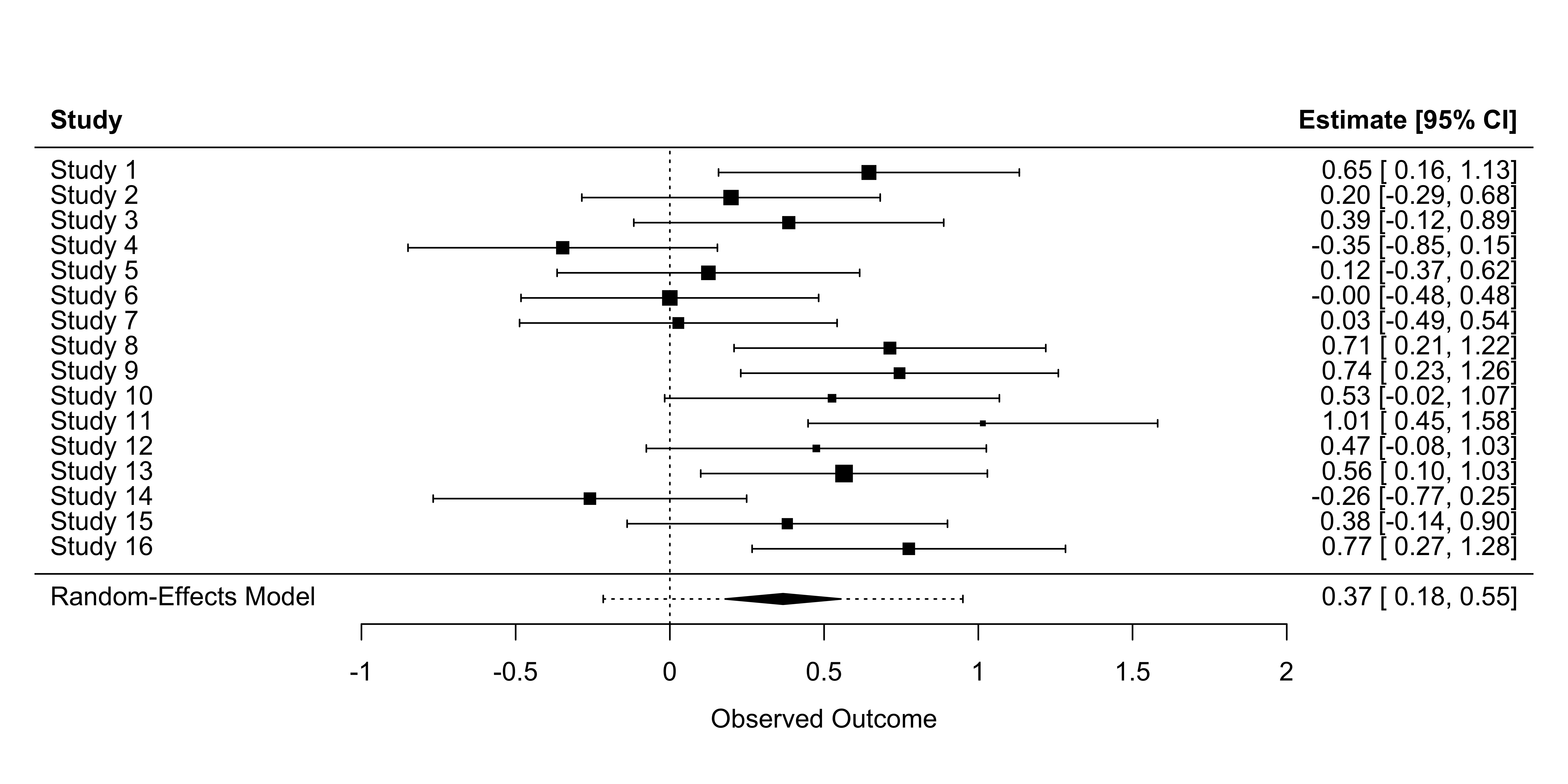
5. Interpretation
We fitted a RE model to \(k = 16\) studies using REML estimation. Unlike the EE model, the RE model explicitly accounts for between-study variance \(\tau^2\), assuming effect sizes vary around a mean true effect.
- Significant heterogeneity detected
- 54.15% of total variability reflects true between-study differences
- 2.18, Observed variability is greater than expected from sampling error alone
- 0.0793 Estimated between-study variance
- Pooled Estimate: 0.3670, se = 0.0957
5. Forest plot
5. Publication bias
Regression Test for Funnel Plot Asymmetry

Model:     mixed-effects meta-regression model
Predictor: standard error

Test for Funnel Plot Asymmetry: z =  1.3296, p = 0.1837
Limit Estimate (as sei -> 0):   b = -2.1327 (CI: -5.8219, 1.5565)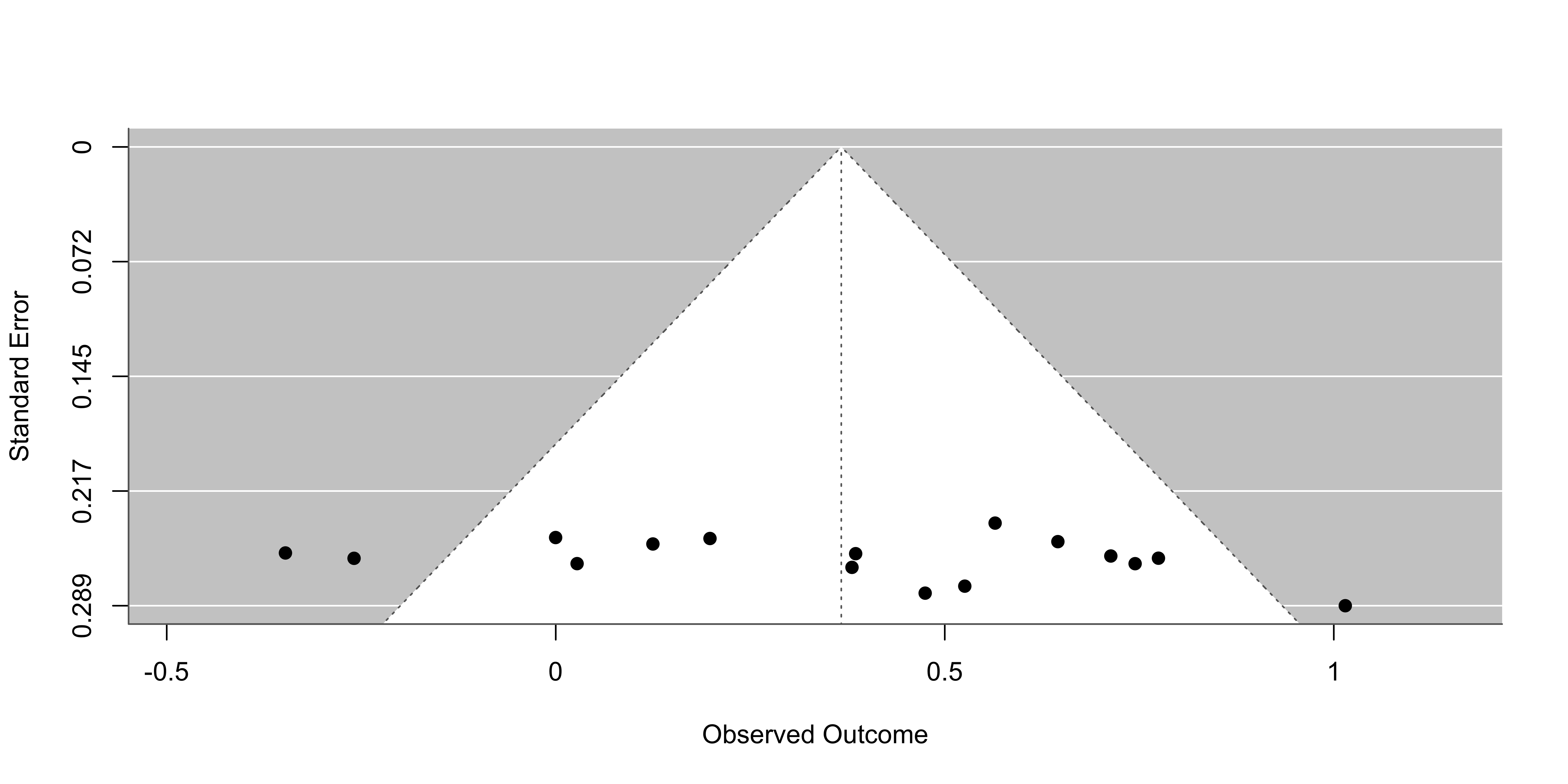
6. Fit a RE-regression model
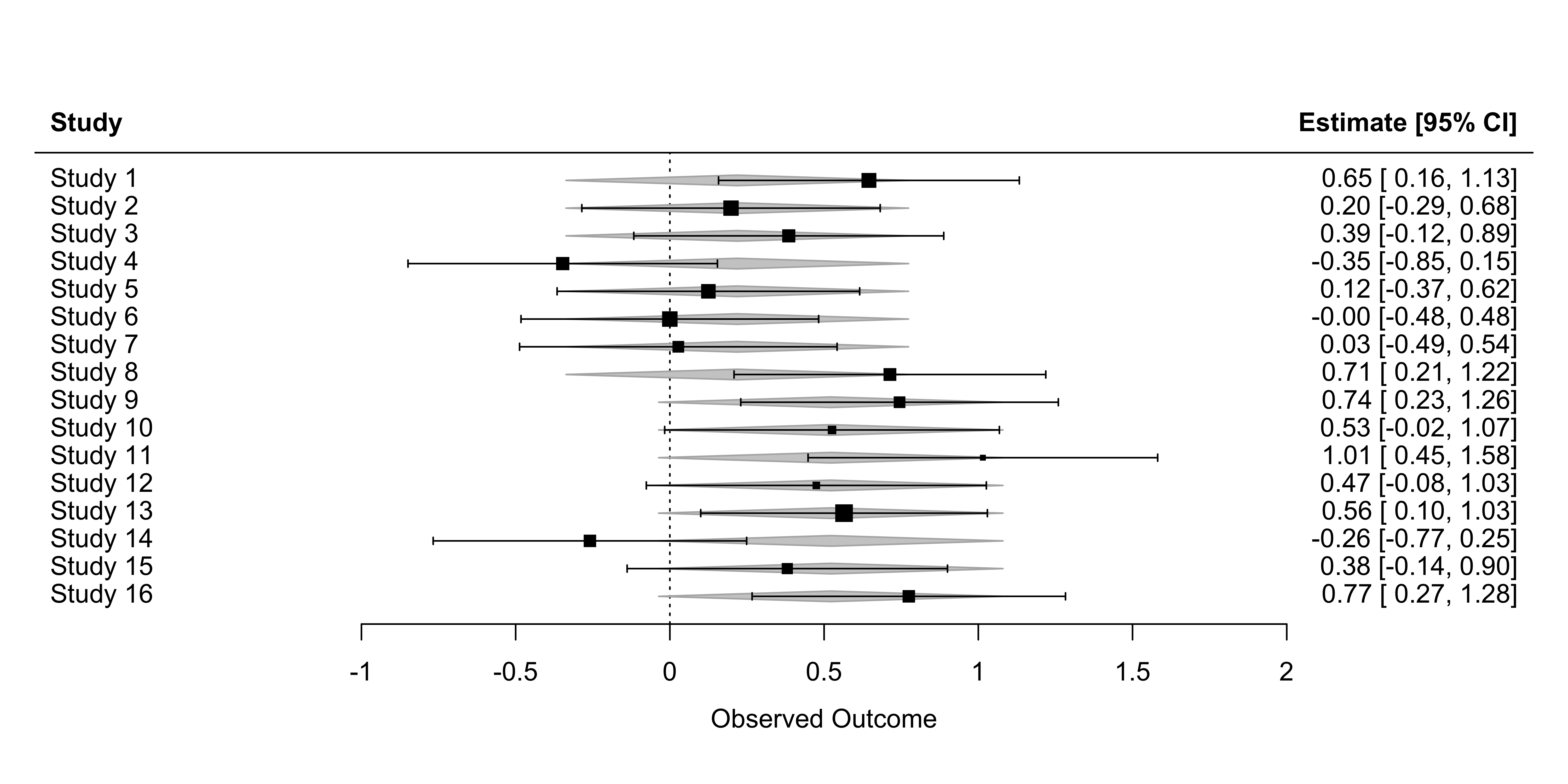
We extended the RE model by including age group (adolescents vs. older adults) as a moderator, using REML estimation across \(k = 16\) studies.
Mixed-Effects Model (k = 16; tau^2 estimator: REML)

tau^2 (estimated amount of residual heterogeneity):     0.0642 (SE = 0.0496)
tau (square root of estimated tau^2 value):             0.2534
I^2 (residual heterogeneity / unaccounted variability): 48.93%
H^2 (unaccounted variability / sampling variability):   1.96
R^2 (amount of heterogeneity accounted for):            19.06%

Test for Residual Heterogeneity:
QE(df = 14) = 27.4025, p-val = 0.0171

Test of Moderators (coefficient 2):
QM(df = 1) = 2.7938, p-val = 0.0946

Model Results:

          estimate      se    zval    pval    ci.lb   ci.ub
intrcpt     0.2186  0.1266  1.7267  0.0842  -0.0295  0.4668  .
ageadult    0.3031  0.1814  1.6715  0.0946  -0.0523  0.6586  .

---
Signif. codes:  0 '***' 0.001 '**' 0.01 '*' 0.05 '.' 0.1 ' ' 1
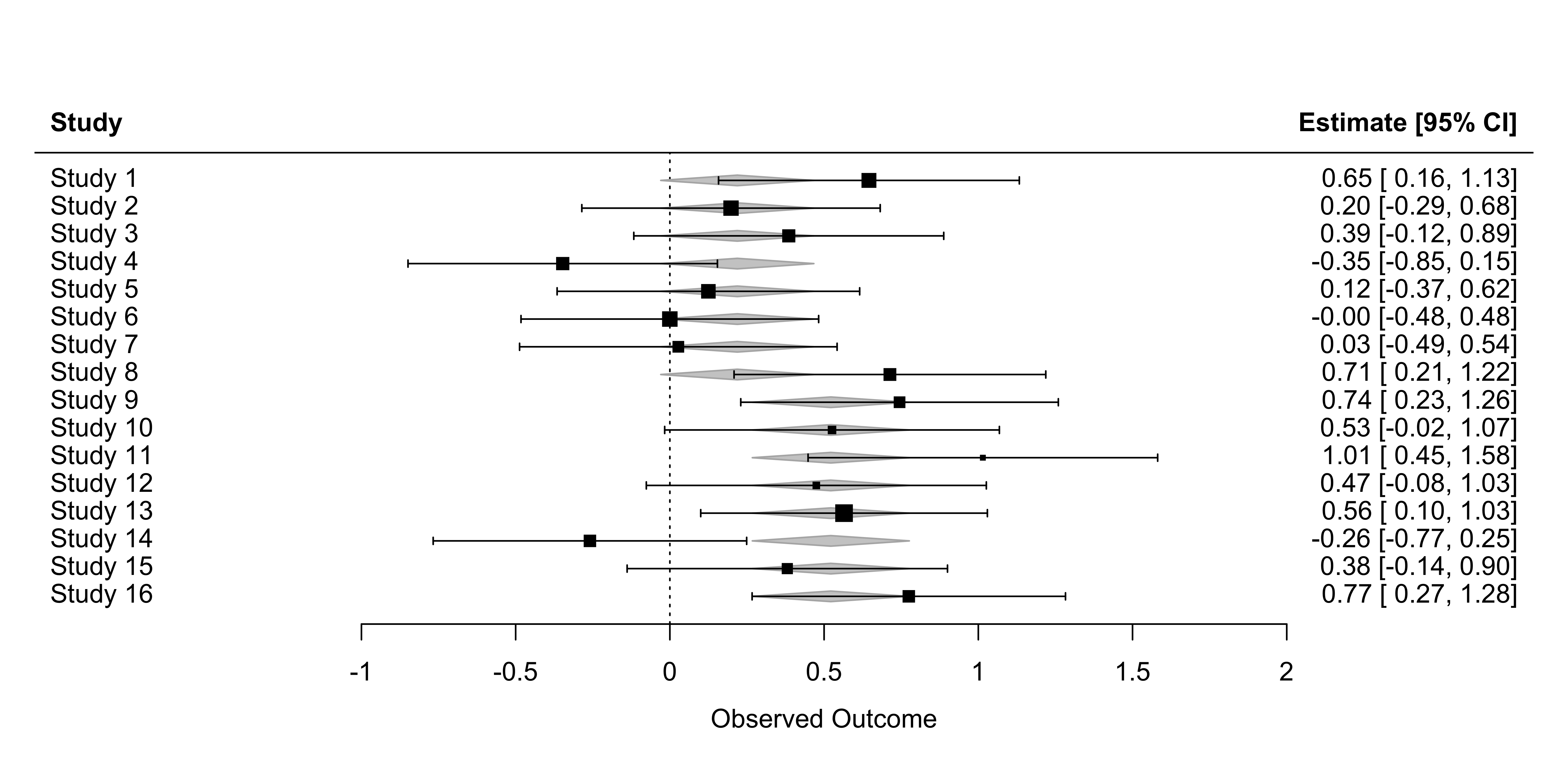
6. Interpretation
We fitted a RE-regression model to \(k = 16\) studies using REML estimation. Unlike the EE model, the RE model explicitly accounts for between-study variance \(\tau^2\), assuming effect sizes vary around a mean true effect.
- Significant residual heterogeneity remains after including the moderator
- 48.93% residual heterogeneity / unaccounted variability
- 1.96, unaccounted variabilityis greater than expected from sampling error alone
- Age group explains 19.06% of the total between-study heterogeneity
- 0.0642 Residual between-study variance after accounting for age (simulated 0.05)
- Age group does not significantly explain between-study variability, p-val = 0.0946
6. Forest plot
6. Forest plot
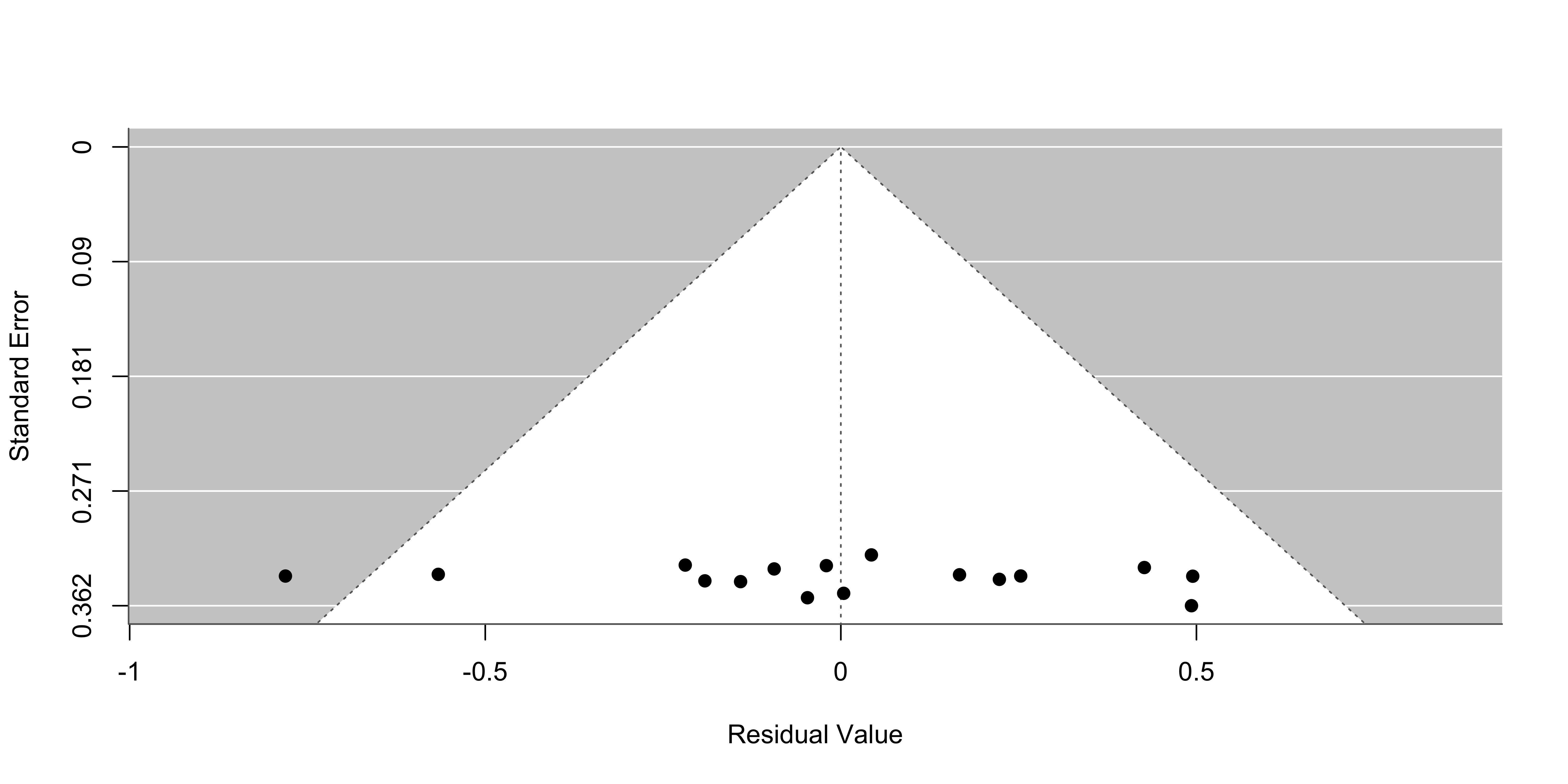
5. Publication bias
Regression Test for Funnel Plot Asymmetry

Model:     mixed-effects meta-regression model
Predictor: standard error

Test for Funnel Plot Asymmetry: z = 0.6362, p = 0.5246